Nicholas Callan: the Maynooth priest who invented the induction coil
High voltages, cast-iron batteries and a 577-cell experiment from the early days of electrical engineering

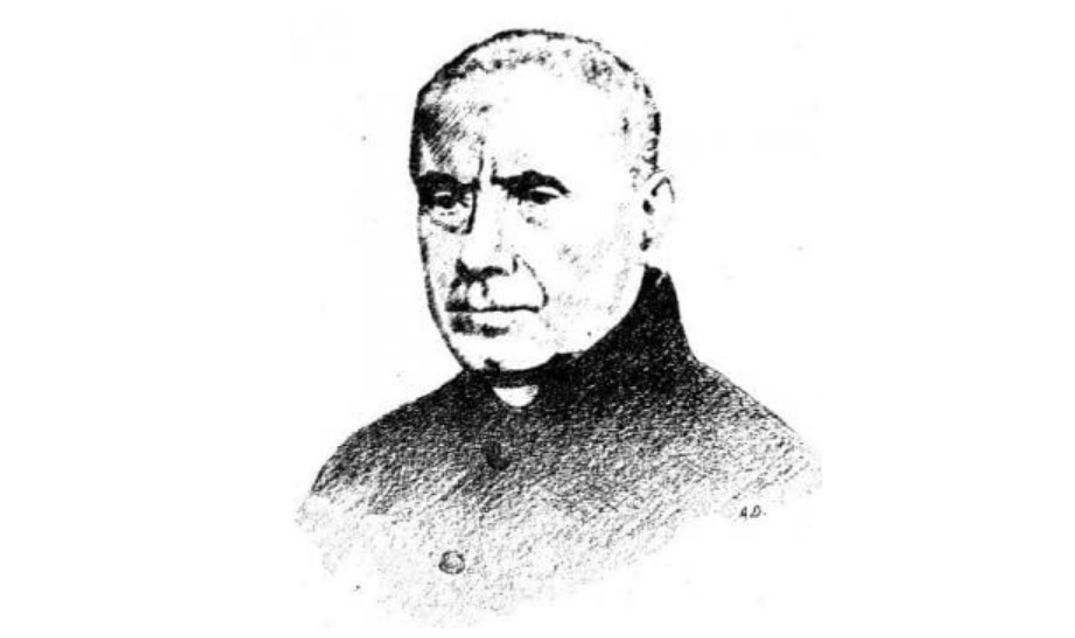
Last week I gave a guest seminar to students in Maynooth University's new MSc in Integrated Circuit Design. On the wall of the Department of Electronic Engineering proudly hangs a portrait of a 19th-century priest: Rev. Nicholas Callan.
I had not known much about him. In 1836, working in a basement laboratory at St Patrick's College, Maynooth, Callan built the first induction coil. That device is the direct ancestor of the step-up transformer and the ignition coil. He also designed some of the most practical and powerful batteries of his time. Finding him on the wall of a university now training chip designers seemed incredibly fitting, so I read up on him.
Who he was
Callan was born in Dundalk, Co. Louth, in December 1799. He trained for the priesthood at Maynooth and then in Rome, where he learned about Volta's battery. In 1826 he became Professor of Natural Philosophy (physics) at Maynooth and held the post until his death in January 1864.
He was influenced by Michael Faraday and by his friend William Sturgeon, who built the first electromagnet. Faraday had shown in 1831 that a changing magnetic field induces a current. Callan then wondered how one could to use that effect to get far higher voltages than any battery of the day could supply.
The induction coil
Callan wound two separate coils of wire around an iron core. The primary had a few turns of thick wire connected to a battery. The secondary, wound over it, had many turns of thin wire. When he broke the battery circuit, the collapsing magnetic field induced a much higher voltage in the secondary, enough to throw sparks across the gap at its ends.
The insight was that the rate of change of the magnetic flux is what matters. Breaking the circuit quickly and often gives a high voltage, repeatedly. To do that, Callan built an automatic interrupter: a rocking wire that dipped in and out of a cup of mercury, making and breaking the primary circuit many times a second.
The ratio of turns in the secondary to turns in the primary sets the step-up in voltage. That is the principle of every step-up transformer. Callan had all the elements of the modern induction coil except the capacitor across the interrupter, which Fizeau added in 1853.
He kept scaling it up. In summer 1837 he sent a small coil to Sturgeon, who used it to give shocks to members of the London Electrical Society. His giant coil of 1845, now in the museum at Maynooth, uses over twenty miles of wire, hand-insulated with beeswax. It is estimated to have produced around 600,000 volts. In 1891 the engineer John Ambrose Fleming reported that it still threw sparks fifteen inches long when run from six of Callan's battery cells.
The Maynooth battery
Callan's coils and electromagnets needed large currents, and the batteries available to him were not good enough. The best cell of the day, the Grove cell, used a platinum electrode, which made it expensive to build in quantity.
Callan showed that cheap cast iron could replace the platinum. In his design the cast-iron casing served as one electrode, with a zinc plate standing in a porous pot in the centre. He published comparisons with Grove cells of the same size in the Philosophical Magazine in 1848. The result, known as the Maynooth battery, went into commercial production in London.
Because the cells were cheap, he could connect them in large numbers. On one occasion he joined 577 cells, using around 30 gallons of acid, which made it the largest battery in the world at the time. He measured the power of his batteries by the weight his electromagnets could lift. Powered by the giant battery, one lifted about two tons.
Other work
While experimenting with battery materials, Callan found a way to protect iron from rusting, an early form of galvanisation. He patented it in 1853. He also found that moving an electromagnet through the Earth's magnetic field produced a current without any battery, and he experimented with early forms of electric lighting and electric motors.
Some of his measurements were direct: he had seminarians hold hands and touch the coil, and judged the current by the strength of the shock they felt.
Credit and legacy
For most of a century, the induction coil was credited to Heinrich Ruhmkorff, a German instrument maker in Paris who sold a refined version from the 1850s, some fifteen years after Callan's first coil. In 1936 Professor P.J. McLaughlin of Maynooth went through Callan's publications and established his priority, which the physics community formally acknowledged in 1953. In 2006 the IEEE dedicated a Milestone at Maynooth to his contributions to electrical science.
The principle he worked out is still in use. The ignition coil in a petrol car steps up 12 volts to the tens of thousands needed to fire a spark plug in the same way. More broadly, the transformer, which descends from his coil, is what allows electricity to be generated, transmitted at high voltage and stepped down for use. Every data centre, laptop and phone charger relies on it before current reaches a single chip.
Many of his coils, batteries and electromagnets are on display at the National Science Museum at Maynooth, alongside his 1853 patent and a reconstruction of his laboratory. If you are on campus, it is worth the visit.