Bet on the kids
AI may eliminate some entry-level tasks, but it could give the next generation an extraordinary advantage.

This is my argument for why, contrary to doomer narrative, I think the future of knowledge work looks extraordinarily bright for people starting their careers. The narrative is that AI is coming for the jobs that young people traditionally use to get started — graduate roles, junior analysts, entry-level software engineering, research assistants, paralegals, marketing coordinators and all the other jobs through which people build the experience that eventually allows them to become senior professionals. And it's not just the AI labs making these claims. The World Economic Forum is examining how AI could reshape entry-level work, while the ILO estimates that 6.1% of jobs held by young people globally are highly exposed to generative AI disruption. Global youth unemployment also rose to 12.4% in 2025, affecting around 67 million people.
AI will undoubtedly eliminate some jobs and change many others. But my view is that the generation entering the workforce now may ultimately have an extraordinary advantage. They are arriving at exactly the moment when the rules governing knowledge work are being rewritten. They have fewer established habits to unlearn, they are adopting AI much earlier, and they can become productive with the technology much faster. The disappearance of some entry-level tasks does not necessarily mean the disappearance of entry-level careers.
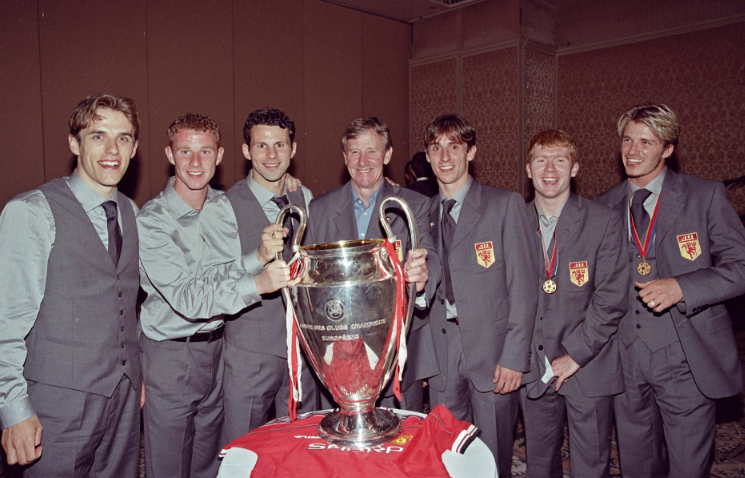
Here's one of my favourite examples of what can happen when you believe in young people. In August 1995, Manchester United lost 3–1 to Aston Villa on the opening day of the Premier League season. United had sold Paul Ince, Mark Hughes and Andrei Kanchelskis, and Alex Ferguson decided to put his faith in a group of young players coming through the club. Gary Neville, Phil Neville, David Beckham, Paul Scholes and Nicky Butt would go on to become central figures in one of the great teams of the modern era. Alan Hansen, speaking on Match of the Day, delivered the line that would follow him for the rest of his broadcasting career: "You can't win anything with kids." United went on to win the Premier League and FA Cup that season.
For argument's sake, compare a 22-year-old and a 42-year-old knowledge worker. The 42-year-old has spent two decades building domain knowledge, developing professional judgment and learning how to operate inside an organisation. The 22-year-old, naturally, has none of that. But many of them have spent the last two years using AI every day, experimenting with models, building agents, and figuring out how to get things done in ways that previous generations couldn't.
My conviction about young people comes from the formative years of my career working under the late Brian Conlon at First Derivatives. Brian had an extraordinary belief in what young people could accomplish. He built First Derivatives from a £5,000 loan from the Newry Credit Union into a global financial technology company, but the part of his legacy that has always mattered most is the thousands of young people whose careers he created. First Derivatives became an extraordinary training ground for graduates, giving people from Ireland and Northern Ireland opportunities to work with major financial institutions around the world.
His instinct was to give talented young people responsibility sooner rather than later, a philosophy that helped create an enormous amount of talent in the Irish technology sector. In my view, he did more to create opportunities for young people in technology in Ireland than anyone else of his generation. His legacy lives on in many ways, but my favourite is the ecosystem of technology companies that now exists up and down the country. So many of the people who came through First Derivatives have gone on to build companies and teams of their own, and many are now applying the same philosophy to the next generation of young people entering the industry.
One of the most interesting studies of generative AI in the workplace is by researchers at Stanford and MIT who examined more than 5,000 customer-support agents using an AI assistant. Productivity increased by around 14% overall, but the effect was dramatically larger among novice and lower-skilled workers, where productivity improved by 34%. The researchers suggested that the AI system was effectively disseminating the practices of the most capable workers to less experienced colleagues, allowing newer workers to move along the experience curve faster.
The traditional organisation accumulates expertise slowly. A graduate joins a company, learns from colleagues, makes mistakes, gradually understands the systems and eventually becomes an expert. AI can compress that process by making expertise available at the point of need. A young analyst can interrogate a huge dataset without knowing every database query. A junior programmer can build sophisticated software while learning the underlying concepts. A graduate researcher can interrogate thousands of documents and papers in hours. In other words, AI can flatten the experience curve. A young person with the right tools can access knowledge, examples and capabilities that previously took years to acquire. The technology effectively puts the accumulated knowledge of an organisation at the fingertips of someone who has only just joined it.
There is an obvious danger. If companies automate every junior task, they can weaken the apprenticeship mechanism through which people become experienced professionals. Recent research on software engineering is already raising this concern, arguing that generative AI could absorb parts of the pathway through which junior developers traditionally become senior developers. The answer should be to redesign how young people learn, take responsibility and develop judgment. Give juniors harder problems sooner, let them use AI to solve them, and make experienced people responsible for teaching them how to judge the answers.
The other reason I'm optimistic is that young people adopt AI much faster than older generations. Eurostat found that 63.8% of Europeans aged 16–24 used generative AI in 2025, almost twice the 32.7% rate across the wider 16–74 population. In Ireland, the CSO found that more than seven in ten internet-using males aged 16–29 had used generative AI, while students were the group most likely to use it overall, at 66%. The most important skill in an environment where the tools are changing every few months may be the willingness to experiment with them in the first place. I know countless people at the beginning of their careers who are genuine experts in AI. They understand models, agents, coding tools, evaluation, automation and the rapidly changing ecosystem around them. I know far fewer people later in their careers who have developed the same depth of understanding. Many experienced professionals have become competent at prompting ChatGPT, which is useful, but there's a significant difference between that and the depth of AI expertise young people are now exhibiting at the beginning of their careers.
The AI industry itself provides a case in point. Some of the most important companies in the AI boom have been built by relatively young people. Sam Altman became CEO of OpenAI in his thirties; Aravind Srinivas co-founded Perplexity in his early thirties; and Anton Osika co-founded Lovable in his early thirties. Lovable is particularly interesting because its growth organisation is run by Elena Verna, who's spent years building growth organisations at companies including Dropbox and Miro. She's repeatedly described how little of her previous playbook maps cleanly to an AI-native company, and that only around 30–40% of what she learned over the years transfers to Lovable. Notably, her allocation of time has effectively inverted from roughly 95% optimisation and 5% innovation to 95% innovation and 5% optimisation. The AI economy is being built around different product cycles, different distribution mechanisms, different economics and radically different rates of iteration. People with decades of experience are throwing out the playbook and learning again. For people entering the workforce now, it creates an unusual advantage: they have less to unlearn.
The strongest argument against the pessimistic view is ultimately economic. AI will reduce the cost of producing many forms of knowledge work. When something becomes dramatically cheaper to produce, the amount of it that gets produced can increase dramatically. Software provides an obvious example. If software development becomes ten times cheaper, we are unlikely to need only one-tenth as much software. We may build vastly more of it. The same logic applies to research, financial analysis, product development, engineering and entrepreneurship. If the cost of building a company falls because a small team can accomplish what previously required dozens of people, more people may start companies. If research becomes cheaper, more organisations can afford to conduct it. If sophisticated analysis becomes accessible to smaller businesses, the market for analysis can expand. This is why forecasting only the jobs that AI can automate is so difficult. We can see the tasks that are disappearing. It is much harder to see the products, companies, industries and jobs that become economically viable because those tasks have become cheap.
If I were starting my career today, I would want to be as close to the frontier of AI as possible. Learn how the technology works. Learn to code, build things and use every model you can get access to. Learn a domain deeply and then figure out how AI changes it. Take risks, because the opportunity is expanding rapidly. The young people who do these things will be formidable. They'll enter organisations with a very different relationship with technology from the generation before them. They will expect software to be programmable, workflows to be automated and knowledge to be queryable. They will be able to get things done with a level of individual leverage that was until recently unimaginable. Some will become the next generation of engineers, researchers and executives. Others will start companies with tiny teams and enormous ambitions. Many will create jobs for people who have not even entered the workforce yet.
The lesson I took from Brian Conlon was that young people are an investment. You cannot know exactly what a 21-year-old is going to become, but you can create the conditions in which they have a chance to become exceptional. Give them responsibility, surround them with talented people, expose them to difficult problems and let them learn quickly. AI has the potential to make that process dramatically more powerful by putting extraordinary amounts of knowledge and capability in the hands of someone at the beginning of their career.
Brian Conlon spent his career betting on that generation. Manchester United did the same thing in 1995. I think the AI era will reward companies and leaders who make the same bet.