The story of the transatlantic cable: How a tiny Irish island changed global communications forever
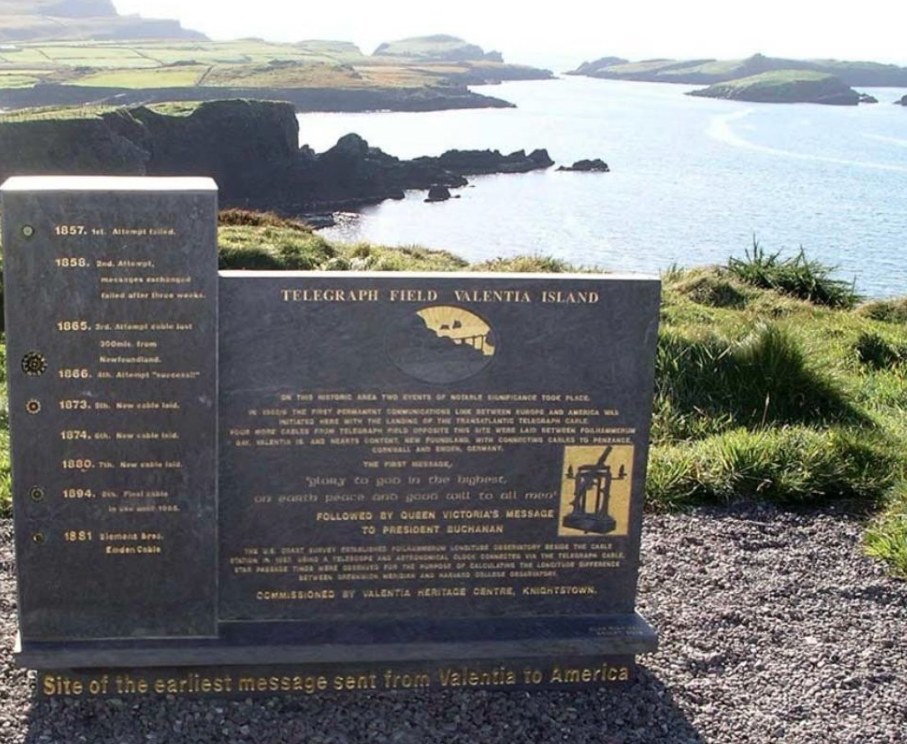
This week, I’m on holiday in Ballinskelligs, Co. Kerry, enjoying the stunning views. But beyond the beauty, there’s a hidden story here that shaped history. Last night, RTE’s documentary 𝘛𝘩𝘦 𝘊𝘢𝘣𝘭𝘦 𝘛𝘩𝘢𝘵 𝘊𝘩𝘢𝘯𝘨𝘦𝘥 𝘵𝘩𝘦 𝘞𝘰𝘳𝘭𝘥 highlighted how Valentia Island, just up the coast, became the European terminal for the first transatlantic cable—a project that transformed global communications. Here’s how:
Before the cable, sending a message across the Atlantic took 12 days by ship. Visionary businessman Cyrus Field dreamed of bridging that gap with a telegraph line and decided to make Valencia Island the starting point for a cable connecting Ireland to Newfoundland, Canada.
To withstand ocean conditions, the cable, an engineering marvel, was made of a 5mm copper wire wrapped in a casing of tar, hemp and steel, resulting in a ton weight per nautical mile, and Belfast-born William Thomson developed the mirror galvanometer for detecting the faint signals travelling through the cable.
The first attempt in 1858 faced difficulties. The cable broke multiple times and the initial connection lasted only a few weeks. However, lessons were learned and by 1865, the SS Great Eastern, the world’s largest ship, was commissioned to lay the cable across the ocean floor.
Wicklow’s Robert Halpin captained the ship during the successful 1866 expedition. His navigational skills ensured the cable was laid smoothly, establishing a reliable link between Valentia and Newfoundland, and the phrase “two weeks to two minutes” was coined.
Ireland’s involvement didn’t end with the cable’s completion. Valentia Island, and nearby Waterville and Ballinskelligs, became centers of telegraphy. Stations were established and locals were trained as telegraph operators.
The first message sent was: “A treaty of peace has been signed between Austria and Prussia”. Queen Victoria then sent a message to the President of the United States. “The Queen congratulates the President on the successful completion of an undertaking which she hopes may serve as an additional bond of Union between the United States and England”. US President James Buchanan called it “a triumph more glorious, because far more useful to mankind, than was ever won by conqueror on the field of battle.”
As I enjoy Ballinskelligs this week, I’m reminded of the extraordinary history made here. The undersea fiber optic cables that carry 99% of international internet traffic today trace their origins back to this first transatlantic cable.And it has left a lasting legacy. Today, Ireland is home to some of the world’s most innovative companies who are engineering ultra-low latency technology to enable real-time information sharing across data centers, financial markets, telco networks and beyond.


